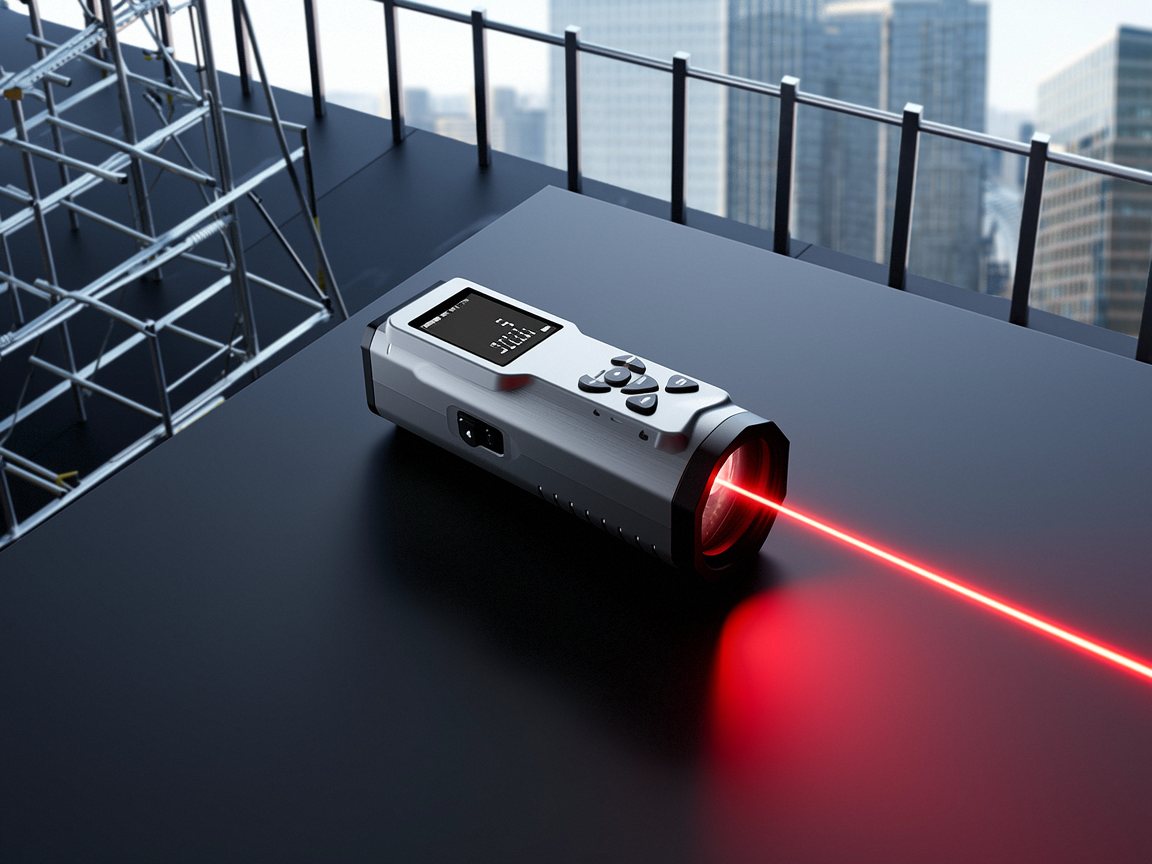
Both laser rangefinders and laser displacement sensors are measurement devices based on laser technology, but they differ in their application scenarios, working principles, and measurement objects. Understanding these differences can help us better select the appropriate sensor to meet different measurement needs.
A laser rangefinder is a device used to measure the distance between an object and a sensor. It measures distance by emitting a laser beam and calculating the time difference between the laser beam's reflection from the target object and its return. Main applications include:
Construction and Building : Used for measuring the height, length, area, etc. of buildings. Laser rangefinders can perform accurate measurements over long distances, eliminating the cumbersome process of traditional measurement methods.
Industrial Measurement : In production lines, laser rangefinders can help detect the position, size, and spacing of objects, ensuring the accuracy of the production process.
Automation and Robotics : In the field of automation, laser rangefinders can be used for robot navigation, obstacle avoidance systems, positioning systems, etc.
Measurement tools : In everyday life, such as home renovation and outdoor adventure, laser rangefinders are also commonly used to measure the area or distance of a room.
Laser displacement sensors focus on measuring the displacement changes of an object's surface relative to the sensor , typically used to detect minute displacements or deformations in a specific direction. Unlike laser rangefinders, displacement sensors emphasize precise displacement measurements. Key applications include:
Industrial automation and quality control : Laser displacement sensors are commonly used in precision machining, assembly lines and other fields to monitor the displacement or deformation of mechanical parts, ensuring the operating accuracy of equipment and the quality of products.
Surface morphology detection : In industries such as semiconductor manufacturing and metal processing, laser displacement sensors can be used to detect minute defects, depressions, roughness, etc. on the surface of objects.
Dynamic monitoring : Used to measure minute displacements or vibrations generated by machines, tools, or components during operation, and is widely used in vibration testing, mechanical testing, and materials testing.
Traffic monitoring : Used to detect deformation and displacement of vehicles or structures such as bridges, especially in real-time monitoring of traffic facilities such as highways and railways.
feature | Laser rangefinder | Laser displacement sensor |
Main functions | Measuring the distance between the object and the sensor | Measuring the displacement or deformation of an object's surface |
Application areas | Measuring large distances, such as in construction, engineering, and automation. | Precision measurement of object surface shape, quality control, dynamic monitoring, etc. |
Accuracy requirements | For large-area distance measurements requiring high accuracy | Extremely high precision is required for minute displacements or deformations. |
Working principle | Distance calculation based on time difference or triangulation. | Displacement changes are detected by using laser reflection and changes in the position of the laser spot. |
Laser rangefinders are mainly used to measure large distances and are suitable for applications such as construction, automation, and robotics, focusing on the distance between the target and the sensor.
Laser displacement sensors focus on high-precision, minute displacement measurement and are widely used in industrial automation, precision machining, quality inspection and other fields. They are particularly good at measuring minute deformations or displacements on the surface of objects.
By understanding both, one can select the appropriate laser measurement equipment based on application requirements.











 +40729977919
  keysensor.ro@gmail.com


